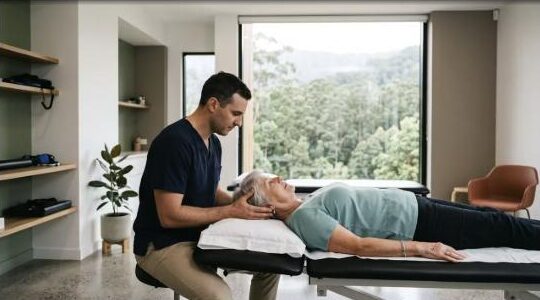
A patient describes low back pain. Deep, one-sided, worse after standing, sometimes spreading into the buttock and down the outside of the thigh.
They have had imaging. The report mentions disc degeneration and facet joint changes, which — in anyone over 50 — is roughly as diagnostic as noting that they have grey hair.
Then someone presses on the gluteus medius, about three centimetres below the iliac crest, and they come off the table. That’s it. That’s the pain.
The referral pattern nobody looks for
Janet Travell and David Simons mapped myofascial trigger point referral patterns across decades of clinical work. Their maps for the gluteal muscles are worth knowing, because they explain an enormous amount of misdiagnosed back and leg pain.
Gluteus medius trigger points refer along the iliac crest, into the sacrum, and across the buttock — presenting as classic low back pain.
Gluteus minimus trigger points refer down the lateral or posterior thigh, past the knee, sometimes to the ankle. This pattern is so convincing that it is regularly diagnosed as sciatica. Travell called gluteus minimus the “pseudo-sciatica muscle.”
Quadratus lumborum trigger points refer to the iliac crest, sacroiliac region and upper buttock.
Piriformis refers into the buttock and posterior thigh.
None of these produce true neurological signs. There is no dermatomal numbness, no reflex change, no true motor weakness in a nerve distribution. But the pain distribution is convincing enough that people are frequently investigated and occasionally operated on for a muscle problem.
Why the glutes end up like this
Here is where the article stops being about needles.
Gluteal trigger points are not random. They develop in muscles that are chronically overloaded relative to their capacity. And gluteus medius in a modern adult is almost universally under-strength.
Gluteus medius has one primary job in gait: stabilise the pelvis during single-leg stance. You spend roughly 40% of walking on one leg. Every single step demands a gluteus medius contraction of around two to three times bodyweight in force.
If that muscle is weak, it is working at a very high percentage of its maximum with every step, thousands of times a day. That is precisely the loading pattern that produces taut bands and trigger points.
So: weak glute medius → chronic overload → trigger points → referred back and buttock pain → reduced activity → weaker glute medius.
What dry needling does
Dry needling inserts a thin filiform needle into a taut band within the muscle, aiming to elicit a local twitch response — a brief involuntary contraction.
The proposed mechanisms are covered in detail in a separate article on this site, but briefly: mechanical disruption of the contracted sarcomere region, reduction in spontaneous electrical activity at the motor endplate, changes in the local biochemical environment (research has shown elevated concentrations of substance P, CGRP and inflammatory mediators at active trigger points, which decrease following a local twitch response), improved local blood flow, and segmental and descending pain modulation.
In practice: the muscle relaxes, tenderness reduces, referred pain often eases immediately, and range of motion improves.
The evidence base for dry needling in low back pain is moderate in quality and shows meaningful short-term benefits for pain and function. The honest limitation is that the long-term evidence for needling as a standalone treatment is much weaker.
Which is exactly the point
Needling the gluteus medius of someone who then goes home and does nothing produces a good week and a return to baseline.
Needling the gluteus medius, and then progressively strengthening it over twelve weeks, produces a muscle that is no longer chronically overloaded — and the trigger points stop coming back.
At Longevity Physio Studio in Eagle Heights, dry needling is the entry, not the plan.
The strength program
Not clams. Not a band around the knees for three sets of fifteen.
Gluteus medius produces two to three times bodyweight in force during gait. Training it with a light band is like training your quadriceps by wiggling your toes.
Effective loading:
- Loaded single-leg work — split squats, step-ups, single-leg RDLs, progressively weighted
- Heavy hip abduction — cable or machine, loaded properly
- Loaded carries, particularly suitcase carries — offset load forces enormous lateral hip stabilisation
- Lateral step-downs with control
- Progressive hip thrusts and bridges for gluteus maximus alongside
Twelve weeks, progressive, measured. Test single-leg stance and hip abduction strength at the start and again at the end.
The longevity connection
Gluteus medius is the muscle that stops your pelvis dropping when you stand on one leg. Which means it is a fall prevention muscle, a hip osteoarthritis muscle, and a gait speed muscle — and gait speed is a well-established mortality predictor.
Treating gluteal pain without building gluteal strength misses the opportunity entirely.
Book an assessment
If you have persistent low back pain, buttock pain, or pain down the leg that hasn’t responded to the usual approaches, it is worth having your glutes properly examined and properly tested.
Longevity Physio Studio, Eagle Heights, Mt Tamborine — serving Tamborine Mountain, North Tamborine, Canungra and the Gold Coast hinterland. Book an assessment.