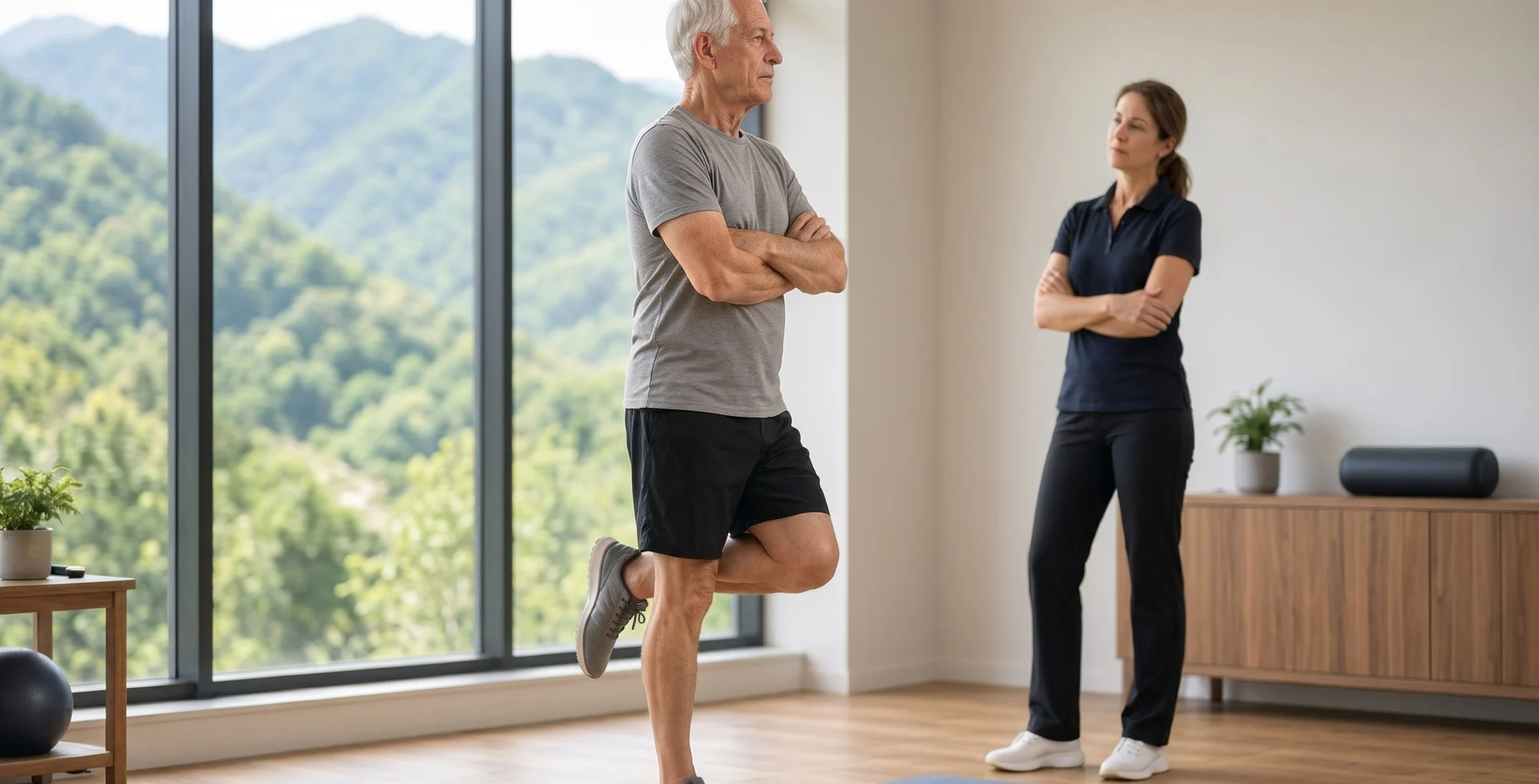
Try this now, safely. Stand close to a kitchen bench or sturdy chair you can grab. Place the front of one foot against the back of the opposite lower leg. Keep your arms by your sides. Look straight ahead. Let go and count to ten.
In 2022, researchers published a study in the British Journal of Sports Medicine that used exactly this test on 1,702 adults aged 51 to 75. About one in five could not do it.
Over roughly seven years of follow-up, those who failed had an 84% higher risk of death from any cause, after adjusting for age, sex, body mass index, and underlying conditions.
Ten seconds. No equipment. No blood draw. It is an observational association, not proof that balance itself is the cause — but it is a remarkably cheap and useful signal.
Why would balance predict death?
Because balance is not one thing. Standing on one leg is a whole-system integration test, and it fails when any component fails.
The hip. Gluteus medius holds your pelvis level over a single stance leg. Weak glute medius means the pelvis drops, the trunk lurches, and the strategy collapses. This is the same muscle that fails in hip osteoarthritis, after hip replacement, and in most people who have sat for a living.
The ankle. Fine, rapid corrections happen at the ankle first. Reduced dorsiflexion range, weak calves, or poor peroneal control and the ankle strategy is unavailable, forcing a clumsy hip-and-arm strategy instead.
Proprioception. The joint position sense feeding your brain from ankle, knee and hip. It degrades with age, with diabetes, and with disuse.
The vestibular system. Your inner ear. Undiagnosed BPPV, vestibular hypofunction, or vestibular migraine all show up as balance failure.
The brain. Standing on one leg is a cognitive task. Attention, processing speed and motor planning all contribute — which is part of why poor balance has been linked with cognitive decline as well as mortality risk.
So a failed 10-second stance is not a “balance problem.” It is a signal that one or more of those systems has quietly gone offline, and the person has been compensating without knowing it.
The chain that actually kills people
Balance failure does not kill you directly. Here is the sequence that does:
Failed balance → a fall → a hip fracture or a head injury → hospital admission → seven to ten days of bed rest → substantial muscle loss → discharge to a lower level of function → reduced activity → accelerated decline.
The fall is the visible event. The fraction of a second in which you could not recover your balance is where it was decided.
What the test does not tell you
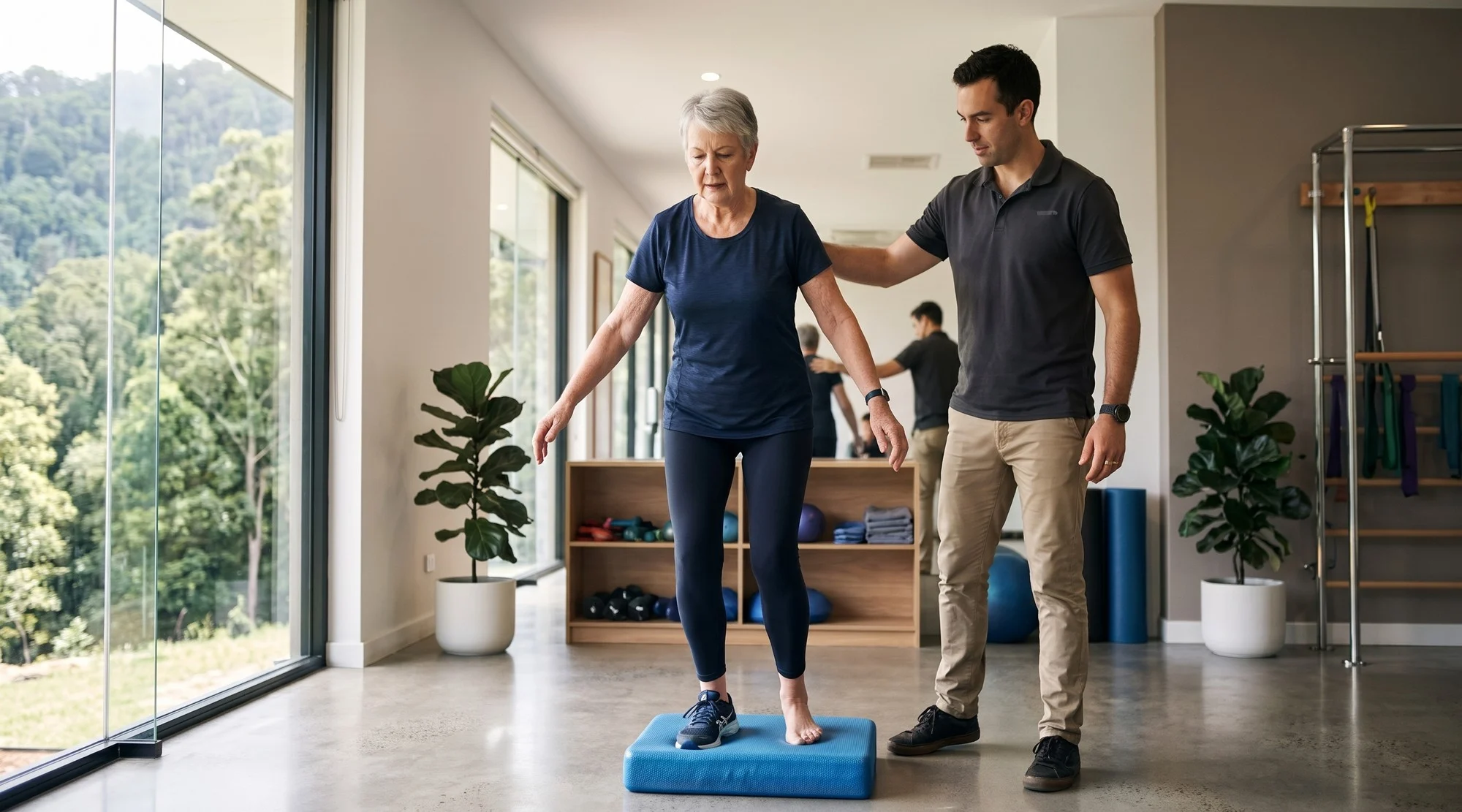
It tells you that something is wrong. It does not tell you what. This is the part where most people go wrong — they Google “balance exercises for seniors,” stand on a wobble cushion for six weeks, and never address the actual deficit.
If the failure is a weak gluteus medius, wobble boards won’t fix it. If it is undiagnosed BPPV, no amount of balance training will touch it — but a single positioning manoeuvre might resolve it in one session. If it is ankle stiffness, the fix is joint mobility and calf strength.
This is why a balance assessment at a physio should include a differential, not just a score.
How we assess balance at Longevity Physio Studio
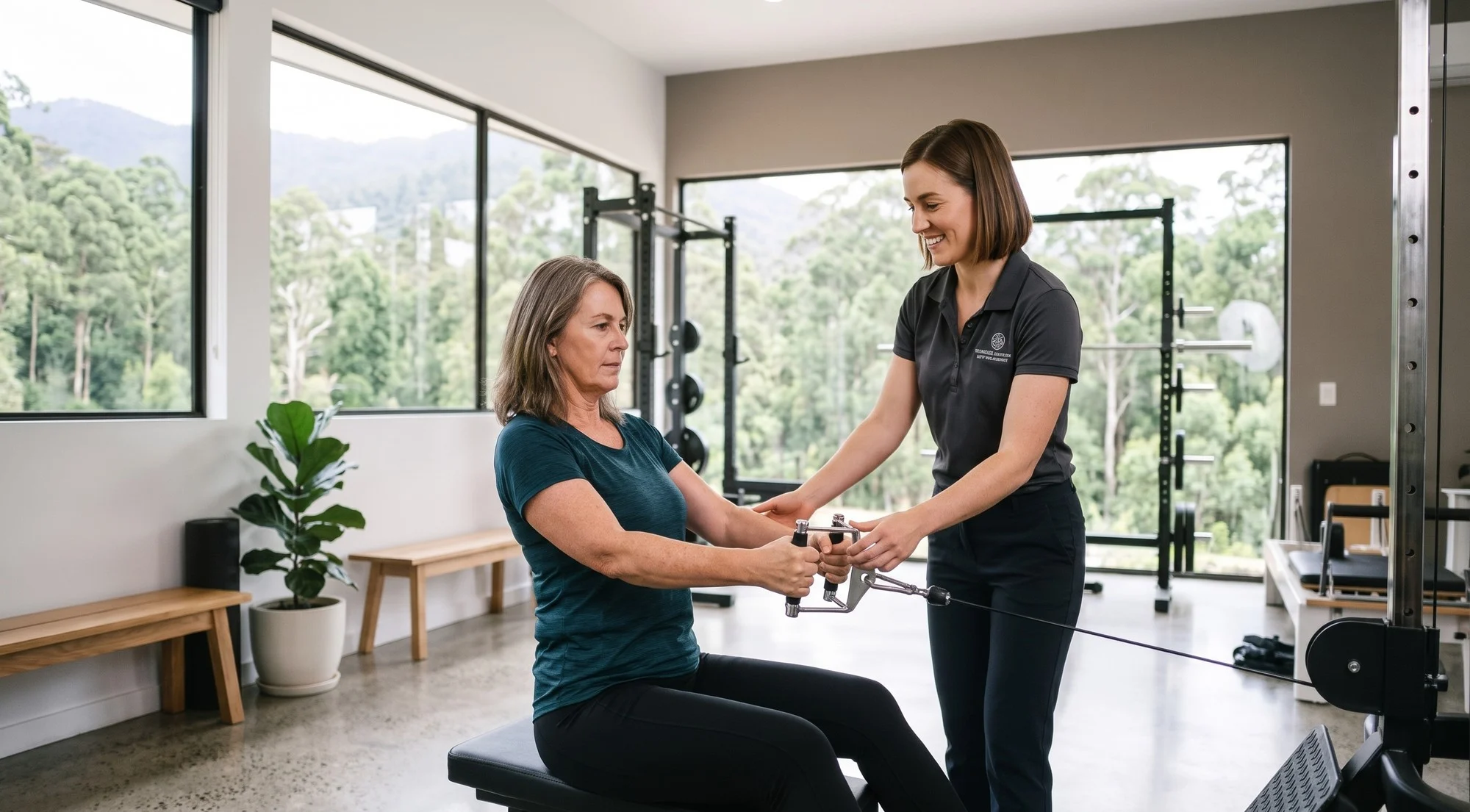
At our Tamborine Mountain studio, a balance assessment typically includes:
- Single-leg stance, eyes open and closed
- Tandem and semi-tandem stance
- Gait speed over 4 metres
- 30-second sit-to-stand
- Hip abductor strength testing
- Ankle dorsiflexion range (knee-to-wall)
- Screening for BPPV and vestibular contribution
- Timed Up and Go, if indicated
That combination separates a hip problem from an ankle problem from an inner ear problem — and the treatment for each is completely different.
Can you train it back?
Yes, and faster than most people expect. Balance is a trainable skill with a steep early learning curve. The components respond differently:
- Vestibular deficits — sometimes resolved in one or two sessions if BPPV is the cause
- Proprioception — improves within weeks with progressive, specific loading
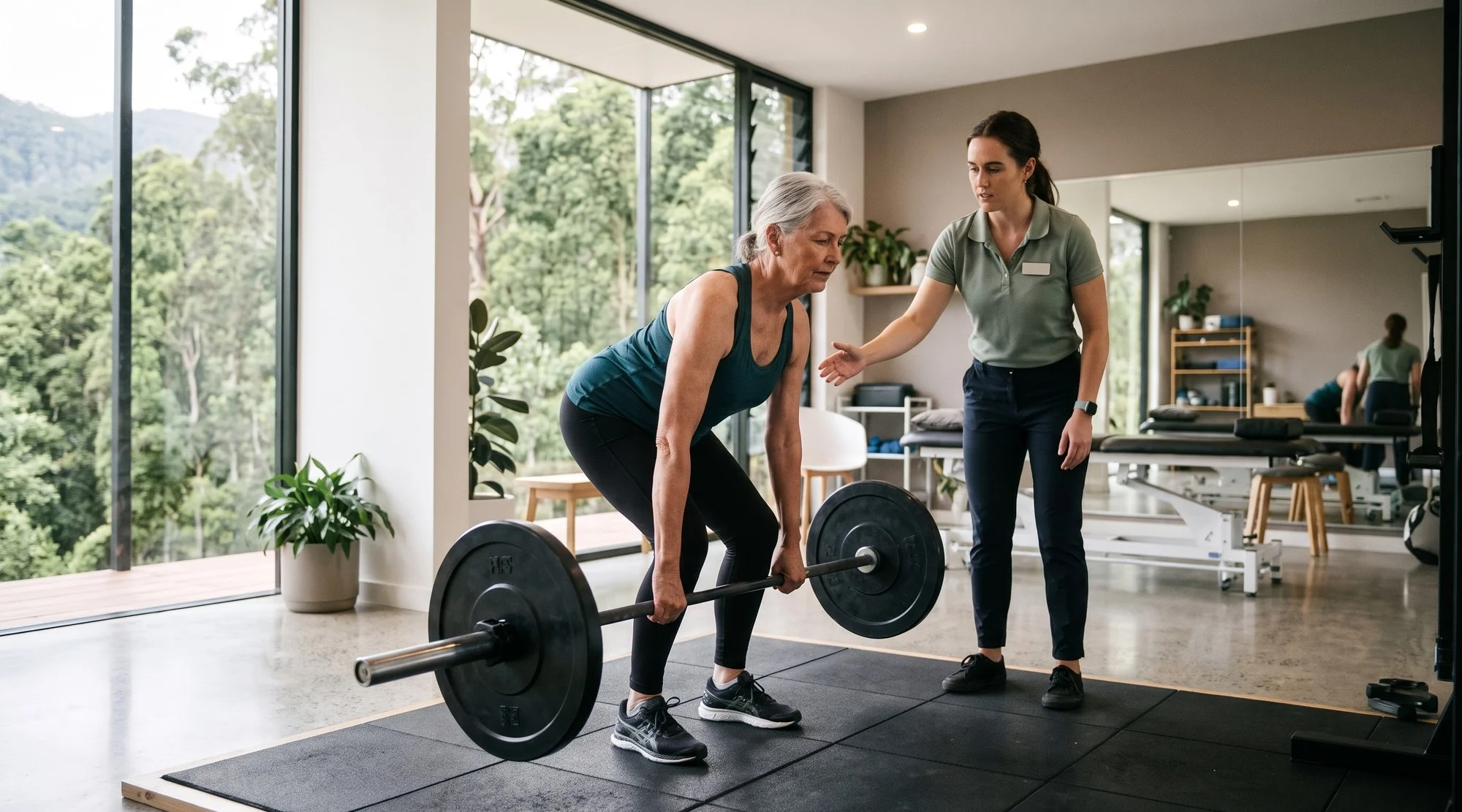
- Hip and ankle strength — 8 to 12 weeks for meaningful change
- Reactive balance — trained with perturbation and step-recovery drills, not static standing
The people who improve most are the ones who thought they were “just getting older.”
Related reading
- Falls Prevention Exercises for Over-65s: What the Evidence Says
- Train Fast, Not Just Heavy: Power Fades Twice as Quickly as Strength
- Ankle Dorsiflexion: The 10 Degrees That Decide Whether You Trip
- Grip Strength: Australian Healthcare’s Most Underused Longevity Metric
Book a balance assessment
If you couldn’t hold ten seconds, that is information, not a verdict. It means something specific is failing, and the specific thing is usually identifiable and usually trainable. Book an assessment and find out which system is letting you down.
See the full list of conditions we treat.
Longevity Physio Studio, Unit 2, 44 Southport Avenue, Tamborine Mountain QLD 4272. Open Monday 6am–5pm, Tuesday 7:30am–5pm and Friday 8am–4pm, with home visits across Mt Tamborine, Canungra, Jimboomba, Beaudesert and Beechmont. Call 0477 012 967 or book online.
Book NowWritten by Dave Cvelbar, physiotherapist (AHPRA PHY0002223680), Longevity Physio Studio. Reviewed November 2026.