At least one in three people over 65 living in the community has a fall each year (Sherrington et al., 2019). Many falls cause only bruises and a fright. Some cause a broken hip or wrist, a head injury, or a loss of confidence that quietly shrinks a person’s world.
Falls are not an inevitable part of ageing. The single most effective way to prevent them is exercise, and the research is clear about what kind and how much.
Important: this is general information. If you’ve had a fall with an injury, fainting, a new dizziness or confusion, see your GP. Dizziness when you turn your head or roll over in bed may be BPPV, which is very treatable. See BPPV: The Five-Minute Manoeuvre That Removes a Fall Risk.
What the evidence says
The most comprehensive review is a Cochrane systematic review of 108 randomised trials with more than 23,000 participants, average age 76 (Sherrington et al., 2019). Its key findings:
- Exercise reduces the rate of falls by about 23%, compared with control. This is high-certainty evidence.
- Balance and functional exercises (for example, standing on one leg, stepping, sit-to-stand) reduce the rate of falls by about 24%, also high-certainty evidence.
- Programmes combining several types of exercise, most commonly balance and functional training plus resistance training, probably reduce the rate of falls by about 34%.
- Tai chi may reduce falls by around 19%, with lower-certainty evidence.
An earlier meta-analysis looked at what makes programmes most effective. Programmes that provided a high challenge to balance and involved more than three hours of exercise a week produced the biggest effect, around a 39% reduction in falls (Sherrington et al., 2017).
The three ingredients
1. Balance that is genuinely challenging
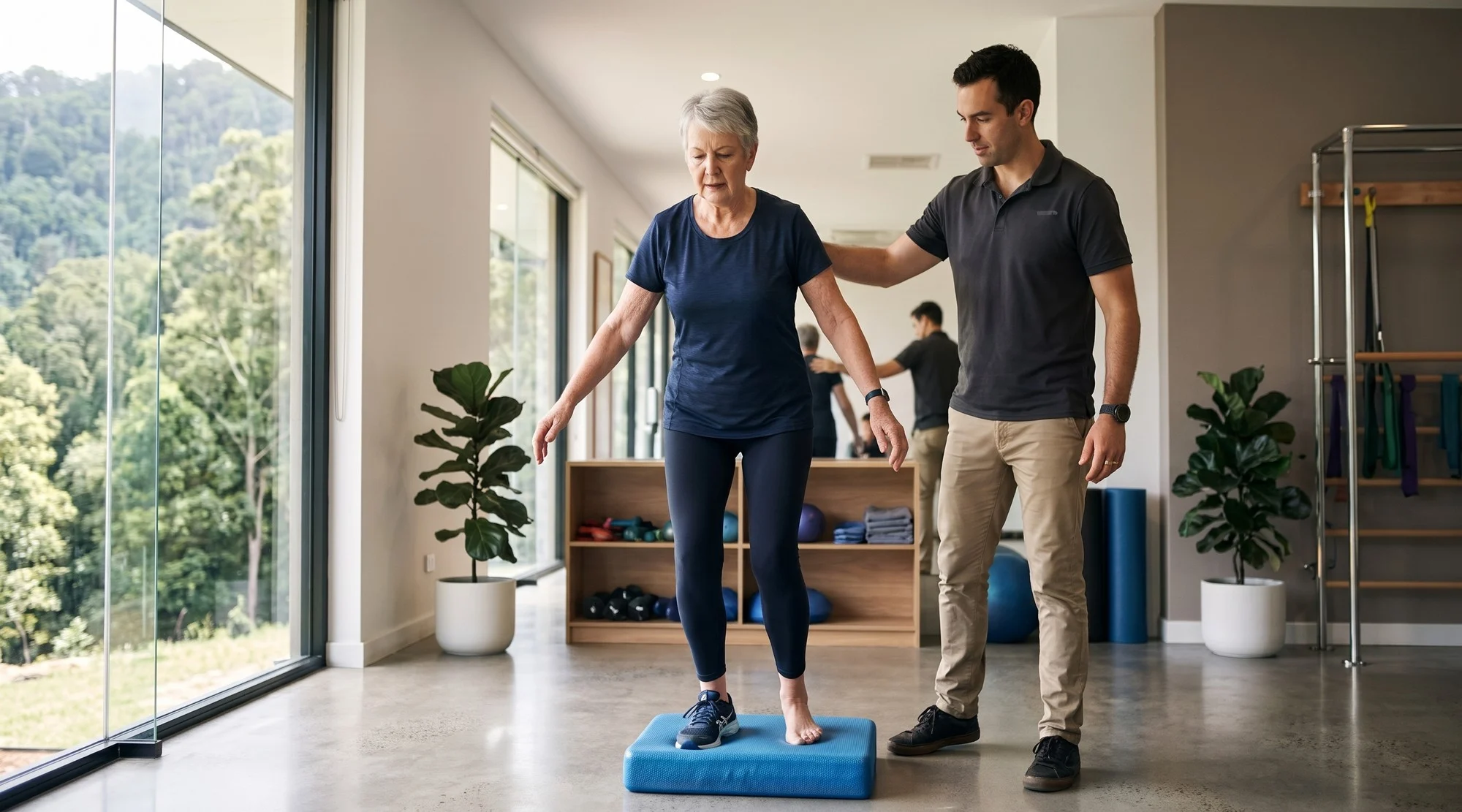
Balance training only works if it is hard enough. That means exercises where you are close to the edge of your balance, safely supported, such as:
- Standing with feet together, then one foot in front of the other (tandem), then on one leg
- Reducing hand support: from two hands on the bench, to one, to a fingertip, to none
- Stepping in different directions, turning, and reaching
- Standing on softer surfaces, or with eyes closed, once you’re ready
A good self-test is standing on one leg, which we explain in Can You Stand on One Leg for 10 Seconds?.
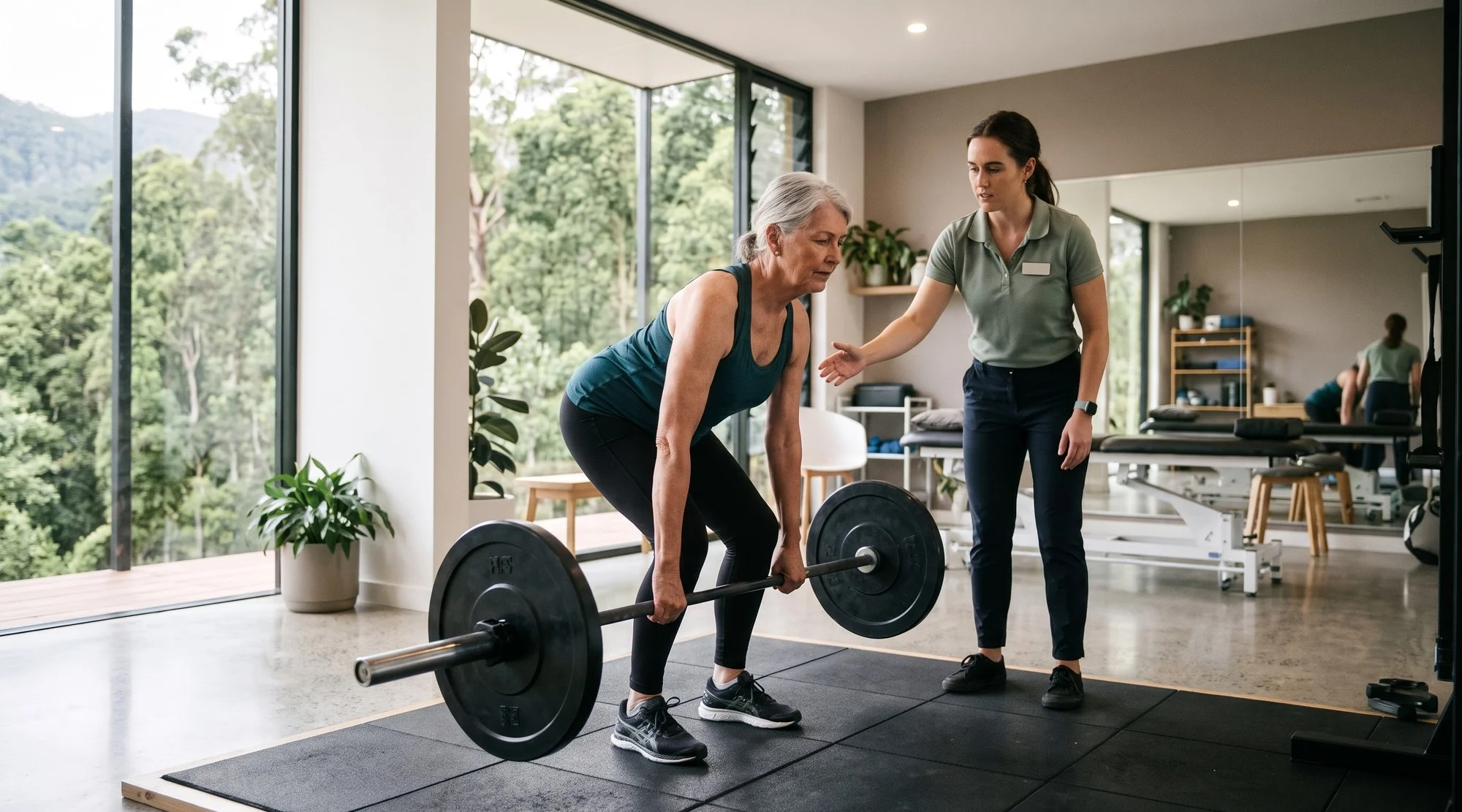
2. Strength, especially in the legs
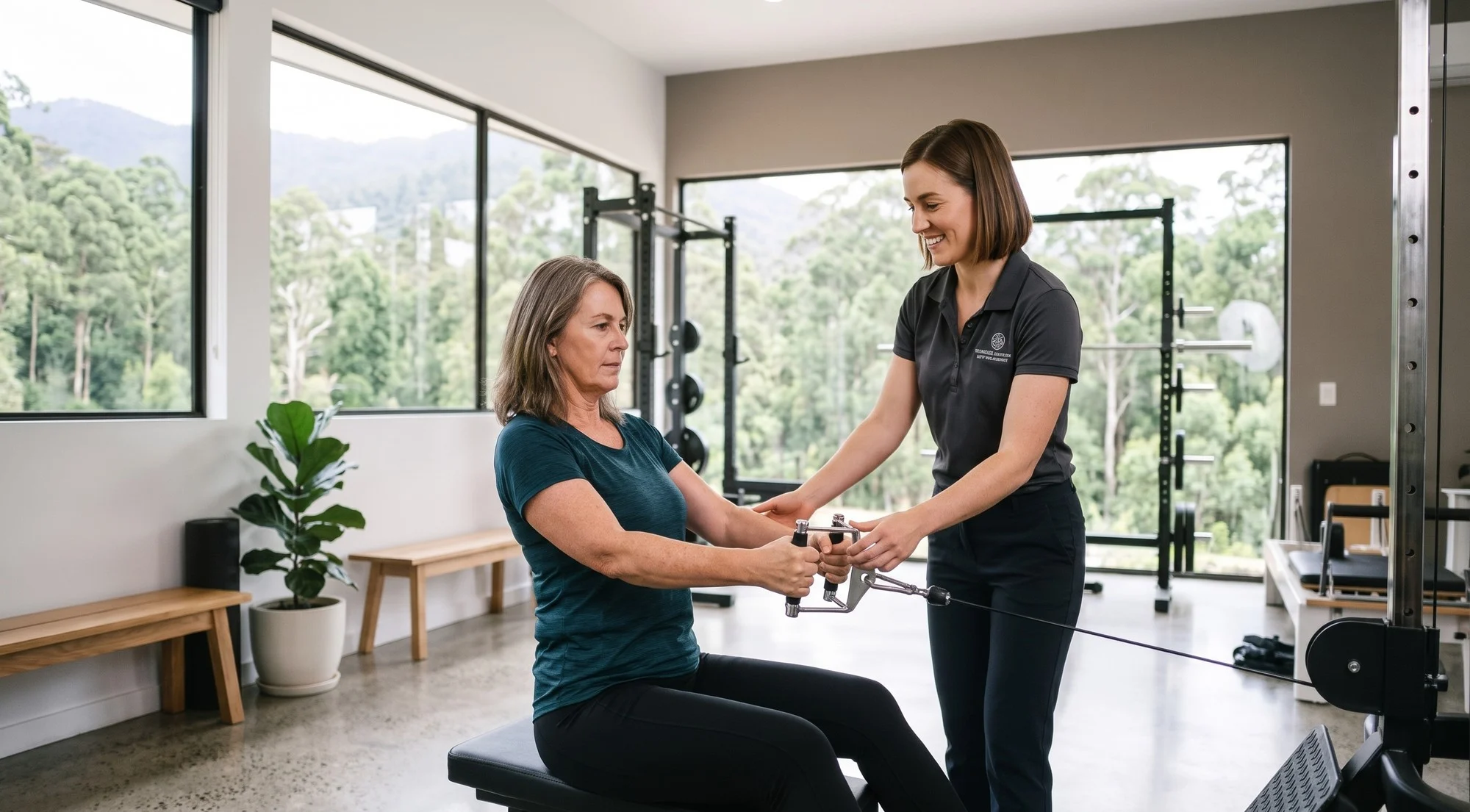
Strong legs let you recover when you trip and get up again if you fall. Key exercises include sit-to-stands, step-ups, calf raises, squats and hip strengthening, progressed with weight. Restricted ankle movement also increases trip risk, as explained in Ankle Dorsiflexion: The 10 Degrees That Decide Whether You Trip.
3. Power and reaction
When you trip, what saves you is a fast step and a fast push from the legs. Power (strength produced quickly) fades faster than strength with age, so it needs training. Fast sit-to-stands, quick steps and controlled stepping reactions are all part of a good programme. We cover this in Train Fast, Not Just Heavy.
How much is enough?
The research points to:
- About three hours a week in total, built up gradually
- Ongoing, not a short course: benefits fade if you stop
- Progression: exercises that stay challenging as you improve
That sounds like a lot, but it adds up quickly: two supervised class sessions a week plus short daily balance practice at home (for example, while the kettle boils) gets most people there.
Doing it safely
- Practise balance next to a kitchen bench or sturdy chair
- Wear supportive shoes, or practise barefoot on a safe floor if you’ve been shown how
- Start with an assessment so the programme matches your balance, strength and any medical conditions
- Tell your GP about any falls, dizziness or new medications
Exercise is the core of falls prevention, but other things matter too: eyesight, medication reviews, foot problems, home hazards, and bone health. If you’ve been told you have low bone density, read Osteopenia vs Osteoporosis: Is It Safe to Lift Weights?.
Why it matters so much
Falls are the leading cause of injury-related hospitalisation and death in older Australians. We look at how big the problem really is in Do Falls Kill More Australians Than Cancer?, and at what a hip fracture means for the year that follows in The Hip Fracture Nobody Warns You About.
The positive message is that this is one of the most preventable problems in older age, and the solution is something you can start this week.
Frequently asked questions
What are the best exercises to prevent falls? Balance and functional exercises that are genuinely challenging, combined with leg strengthening. Programmes that combine both reduce falls the most.
Is walking enough to prevent falls? Walking is great for general health, but on its own it isn’t a falls-prevention programme. The effective programmes specifically challenge balance and build leg strength.
Does tai chi help? Tai chi may reduce falls, although the evidence is less certain than for balance and strength programmes. It’s a good option if you enjoy it.
I’m already unsteady. Is it safe to start? Yes, with the right starting point. That’s exactly who benefits most. An assessment lets us start you safely and progress at the right pace.
How quickly will I improve? Most people notice better confidence and steadiness within a few weeks, with falls-prevention benefits building over months of consistent training.
Stand Strong on Tamborine Mountain
Our Stand Strong class is built on this research: challenging balance work, leg strength and power, in a small supervised group. Read more on our Longevity Classes page, or see the full list of conditions we treat. Home visits are available if getting to the studio is difficult.
Longevity Physio Studio, Unit 2, 44 Southport Avenue, Tamborine Mountain QLD 4272. Open Monday 6am–5pm, Tuesday 7:30am–5pm and Friday 8am–4pm, with home visits across Mt Tamborine, Canungra, Jimboomba, Beaudesert and Beechmont. Call 0477 012 967 or book online.
Book a Falls AssessmentRelated reading
- Can You Stand on One Leg for 10 Seconds? The Test That Predicts the Next Decade
- Do Falls Kill More Australians Than Cancer? The Honest Answer
- BPPV: The Five-Minute Manoeuvre That Removes a Fall Risk
- Train Fast, Not Just Heavy: Power Fades Twice as Quickly as Strength
References
- Sherrington C, Fairhall NJ, Wallbank GK, et al. Exercise for preventing falls in older people living in the community. Cochrane Database Syst Rev. 2019;1(1):CD012424. doi:10.1002/14651858.CD012424.pub2
- Sherrington C, Michaleff ZA, Fairhall N, et al. Exercise to prevent falls in older adults: an updated systematic review and meta-analysis. Br J Sports Med. 2017;51(24):1750–1758. doi:10.1136/bjsports-2016-096547
Written by Dave Cvelbar, physiotherapist (AHPRA PHY0002223680), Longevity Physio Studio. Reviewed November 2026.