“You’ve got a rotator cuff tear.” For a lot of people over 50, those words arrive with an ultrasound report and an immediate assumption: surgery.
Sometimes that’s right. Often it isn’t. The single most important question is not whether the tendon is torn, but how it tore, how big the tear is, and who it belongs to. This guide walks through what the research and the latest orthopaedic guideline say, so you know which path fits your shoulder.
Important: this article is general information, not a diagnosis. If you suddenly can’t lift your arm after a fall or injury, see your GP or an emergency department promptly — timing matters for that kind of tear.
What the rotator cuff is
The rotator cuff is a group of four muscles and their tendons — supraspinatus, infraspinatus, teres minor and subscapularis — that wrap around the ball of the shoulder. They keep the ball centred in the socket while the bigger muscles move the arm. Supraspinatus, across the top of the shoulder, is the tendon most often torn.
Tears are described as partial-thickness (part of the tendon’s depth) or full-thickness (a hole all the way through), and by size, usually in centimetres.
Two very different kinds of tear
Degenerative (non-traumatic) tears
These develop gradually as tendons age, usually in people over 50, often with no single injury. They are extremely common — and frequently painless.
In a Japanese village where more than 660 residents had both shoulders scanned, 22.1% had a full-thickness rotator cuff tear. The rate climbed with age: 0% in people in their 20s to 40s, 10.7% in their 50s, 15.2% in their 60s, 26.5% in their 70s and 36.6% in their 80s. Painless tears were twice as common as painful ones (Minagawa et al., 2013).
That matters. If a third of people in their 80s have a tear, many with no symptoms at all, then finding a tear on your scan does not prove it is the cause of your pain. Often the pain comes from an irritated, under-loaded tendon and bursa — the same picture we describe in Rotator Cuff Tendinopathy: Load It, Don’t Rest It.
Acute traumatic tears
These happen with a definite injury — a fall onto an outstretched arm, catching a heavy load, a dislocation — followed by sudden pain and, crucially, sudden weakness: you can’t lift the arm out to the side or overhead the way you could the day before.
These tears behave differently. Torn tendon can retract and the muscle can waste over time, which makes later repair harder. A systematic review of acute tears found outcomes can vary with delayed time to surgery (Mukovozov et al., 2013), and many surgeons aim to assess these tears early. The research on exact timing is mixed, but the practical message is clear: a sudden, weak shoulder after an injury needs prompt imaging and a surgical opinion, not months of waiting.
Degenerative tears: what the trials show
Physio performs as well as surgery for small tears in over-55s
In a Finnish trial, 180 shoulders with symptomatic, non-traumatic supraspinatus tears in people over 55 were randomised to physiotherapy alone, acromioplasty plus physiotherapy, or full rotator cuff repair plus acromioplasty and physiotherapy. At one year there was no difference between the groups (Kukkonen et al., 2014). At more than five years’ follow-up (mean 6.2 years) there was still no significant difference in function, pain or satisfaction, and surgery did not protect against later arthritis or cuff-tear arthropathy. The authors concluded that conservative treatment is a reasonable first option for these tears (Kukkonen et al., 2021).
But tears can grow, and repair has advantages for some people
A Norwegian trial randomised 103 people with tears up to 3 cm to early tendon repair or physiotherapy, with surgery later if needed. At 10 years, the repair group had better scores, and the gap between groups had widened over time. Among tears left unrepaired, 41% had enlarged by more than 10 mm, and those enlargements were linked to poorer outcomes. The authors felt this supports primary repair in younger, active patients (Moosmayer et al., 2019).
The American Academy of Orthopaedic Surgeons’ updated 2025 guideline reflects both findings: there is moderate evidence that, compared with non-operative care, repair gives better patient-reported and functional outcomes when the repair heals (AAOS, 2025).
Putting it together
The evidence doesn’t say “never operate” or “always operate”. It says the decision depends on who you are and what kind of tear you have:
- Older, less demanding shoulder, degenerative tear, no sudden weakness: a well-structured rehab programme is a strong first choice, with surgery kept in reserve if it isn’t working.
- Younger or very active, or a tear that is enlarging or causing real weakness: a surgical opinion early is sensible, because repair tends to do better when the tendon is still repairable.
- Sudden weakness after an injury: get assessed promptly.
A good physio should help you work out which group you’re in, monitor your progress against clear targets, and refer you on without delay if you aren’t on track.
What good rotator cuff tear rehab looks like
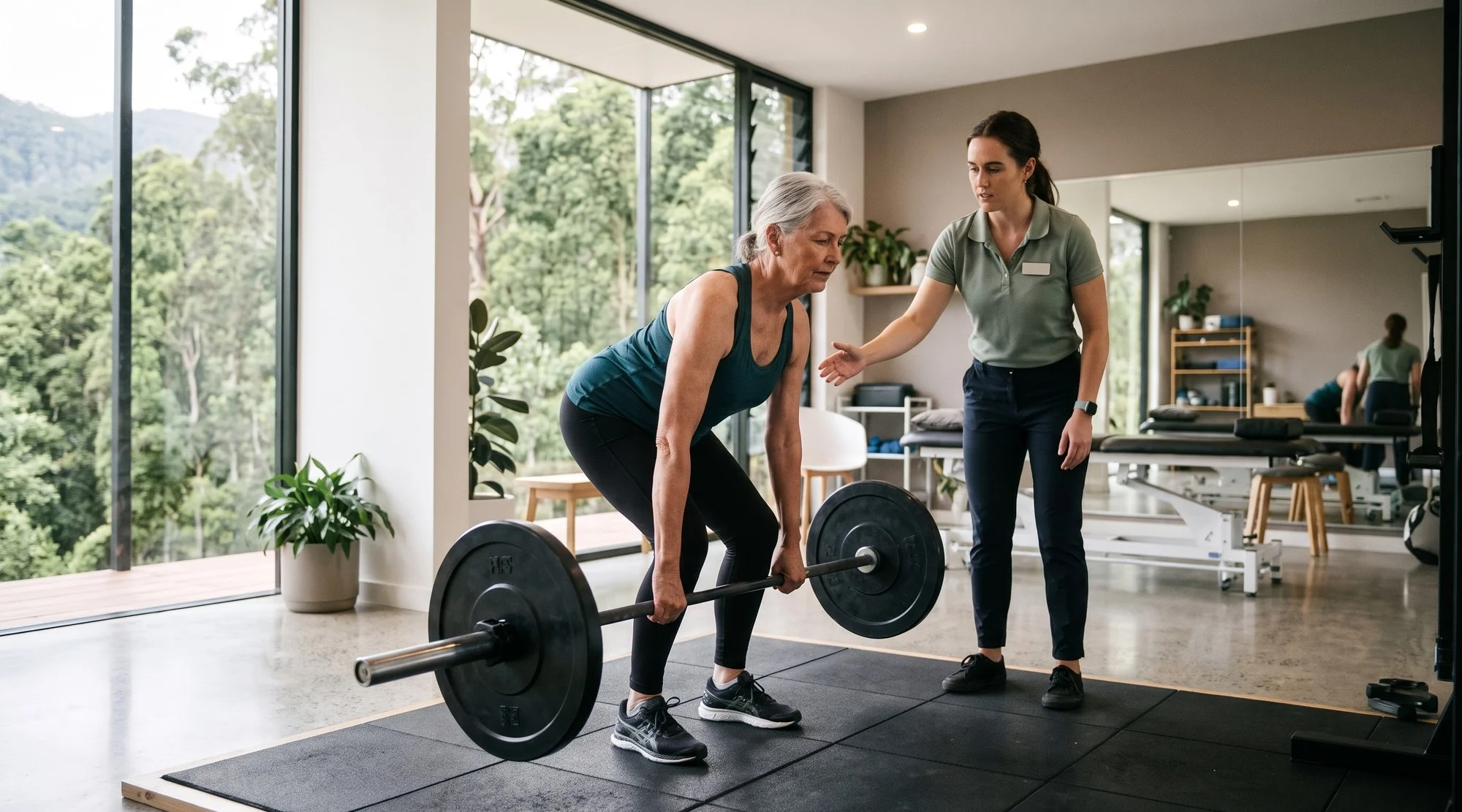
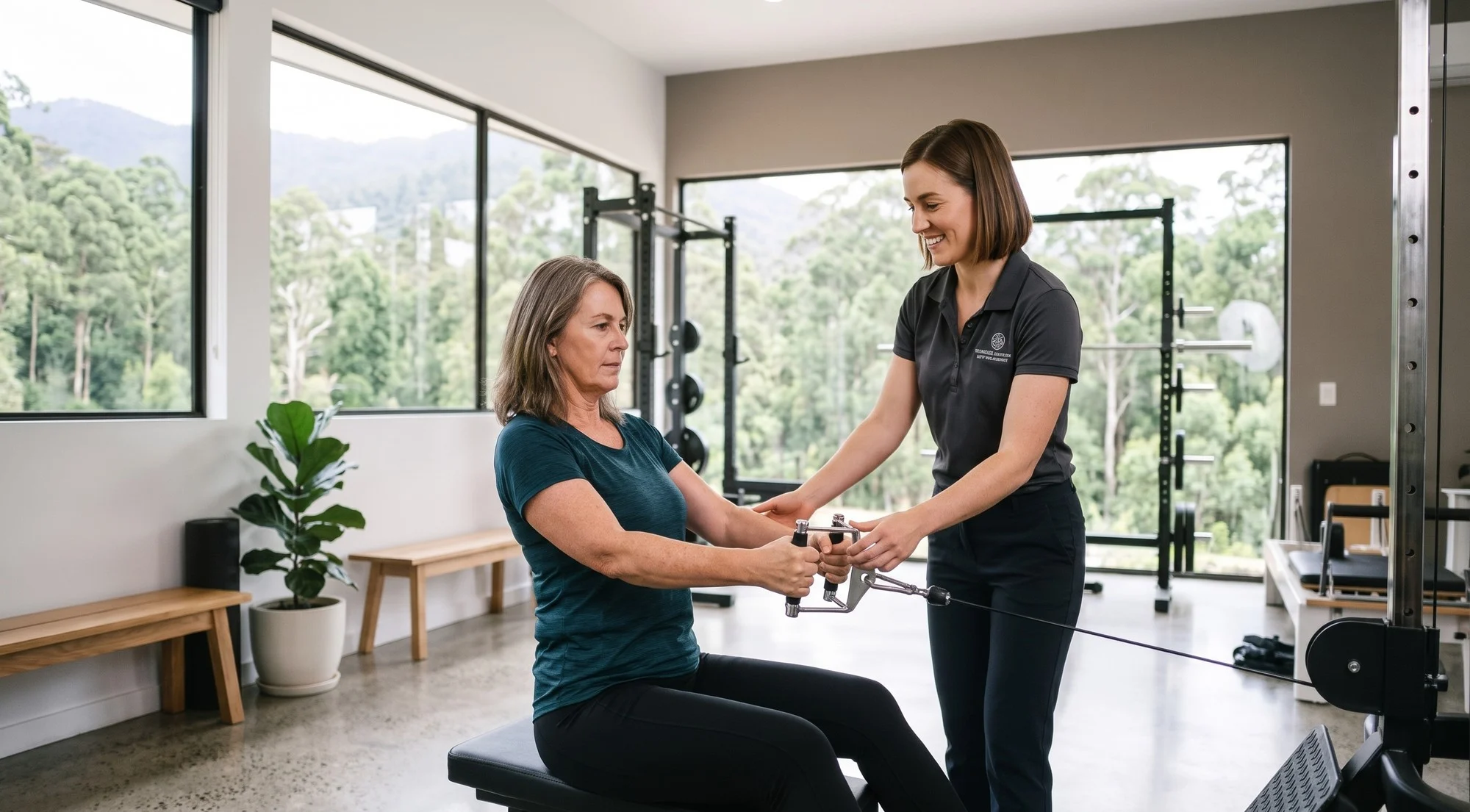
Rehab for a degenerative tear is not three sets of light band exercises forever. It is progressive loading of the muscles that remain working, so they can take over the job of the torn tendon and keep the ball of the shoulder centred.
1. Settle the pain. Modify, don’t stop. Isometric holds (pushing against a wall or band without moving) often ease pain enough to start loading. A single corticosteroid injection can be considered for short-term relief of pain and function (AAOS, 2025) — useful as a window to start rehab, not as the treatment itself.
2. Restore movement. Regain comfortable range through the shoulder and upper back. A stiff thoracic spine and poor shoulder-blade rotation make the cuff work harder.
3. Build strength in the remaining cuff and the shoulder blade. External and internal rotation, then the deltoid and the shoulder-blade muscles, progressed to genuine loads. Strong anterior deltoid and remaining cuff can compensate remarkably well for a torn supraspinatus.
4. Rebuild overhead capacity. Gradually reintroduce reaching, lifting and pressing overhead. Overhead work is the goal, not a movement to avoid forever.
5. Train for your actual life. Gardening on a Tamborine Mountain slope, swimming, golf, hanging washing, lifting grandchildren, pushing yourself up off the floor. Rehab should end where your life starts.
Most people need about 3 months of consistent, progressive work to judge whether rehab is succeeding. If pain at night, weakness or function aren’t clearly improving by then, it’s time to talk to a surgeon.
Other causes of shoulder pain and stiffness can look similar, including frozen shoulder, which needs a different approach. Getting the diagnosis right comes first.
Why shoulder strength matters for long-term health
Upper-body strength decides whether you can break a fall with your arms, push yourself out of a chair, or get up off the floor. A painful shoulder that stops you loading your arms for years quietly costs muscle and bone. Getting it strong again is part of staying independent, which is why upper-body work is built into our strength classes. If you want a simple marker to track, grip strength is a good place to start.
Frequently asked questions
Can a rotator cuff tear heal without surgery? A full-thickness tear generally doesn’t knit back together on its own, but many people regain good, pain-free function without surgery because the surrounding muscles can be strengthened to compensate.
How do I know if my rotator cuff tear needs surgery? Signs that point towards a surgical opinion include a sudden injury with immediate weakness, being younger or very active, a tear that is enlarging, or failure to improve after around 3 months of good rehab.
Should I rest a torn rotator cuff? Short-term relative rest from aggravating tasks is fine, but long-term rest weakens the remaining muscles. Guided, progressive loading is what restores function.
Is a partial-thickness tear serious? Partial tears are common, especially after 50, and most are managed well with rehab. They’re often part of the same picture as rotator cuff tendinopathy.
Can I still exercise with a rotator cuff tear? Yes. In fact, the right exercise is the treatment. The key is choosing the right load and progressing it.
Related reading
- Rotator Cuff Tendinopathy: Load It, Don’t Rest It
- Frozen Shoulder Isn’t Random — It’s Metabolic
- Tight Traps: The Real Cause and the Fix
- Grip Strength: Australian Healthcare’s Most Underused Longevity Metric
Get your shoulder assessed on Tamborine Mountain
If you’ve been told you have a rotator cuff tear, or your shoulder is painful and weak reaching overhead, a thorough assessment will establish what kind of tear you’re likely dealing with, what your shoulder can tolerate now, and whether rehab or a surgical opinion is the right first step. See our physiotherapy services.
See the full list of conditions we treat.
Longevity Physio Studio, Unit 2, 44 Southport Avenue, Tamborine Mountain QLD 4272. Open Monday 6am–5pm, Tuesday 7:30am–5pm and Friday 8am–4pm, with home visits across Mt Tamborine, Canungra, Jimboomba, Beaudesert and Beechmont. Call 0477 012 967 or book online.
Book a Shoulder AssessmentReferences
- American Academy of Orthopaedic Surgeons. Management of Rotator Cuff Injuries: Evidence-Based Clinical Practice Guideline. 2025.
- Minagawa H, et al. Prevalence of symptomatic and asymptomatic rotator cuff tears in the general population: from mass-screening in one village. J Orthop. 2013;10(1):8–12.
- Kukkonen J, et al. Treatment of non-traumatic rotator cuff tears: a randomised controlled trial with one-year clinical results. Bone Joint J. 2014;96-B(1):75–81.
- Kukkonen J, et al. Operative versus conservative treatment of small, nontraumatic supraspinatus tears in patients older than 55 years: over 5-year follow-up of a randomized controlled trial. J Shoulder Elbow Surg. 2021. doi:10.1016/j.jse.2021.03.133
- Moosmayer S, et al. At a 10-year follow-up, tendon repair is superior to physiotherapy in the treatment of small and medium-sized rotator cuff tears. J Bone Joint Surg Am. 2019;101(12):1050–1060.
- Mukovozov I, et al. Time to surgery in acute rotator cuff tear: a systematic review. Bone Joint Res. 2013;2(7):122–128.
Written by Dave Cvelbar, physiotherapist (AHPRA PHY0002223680), Longevity Physio Studio. Reviewed November 2026.